
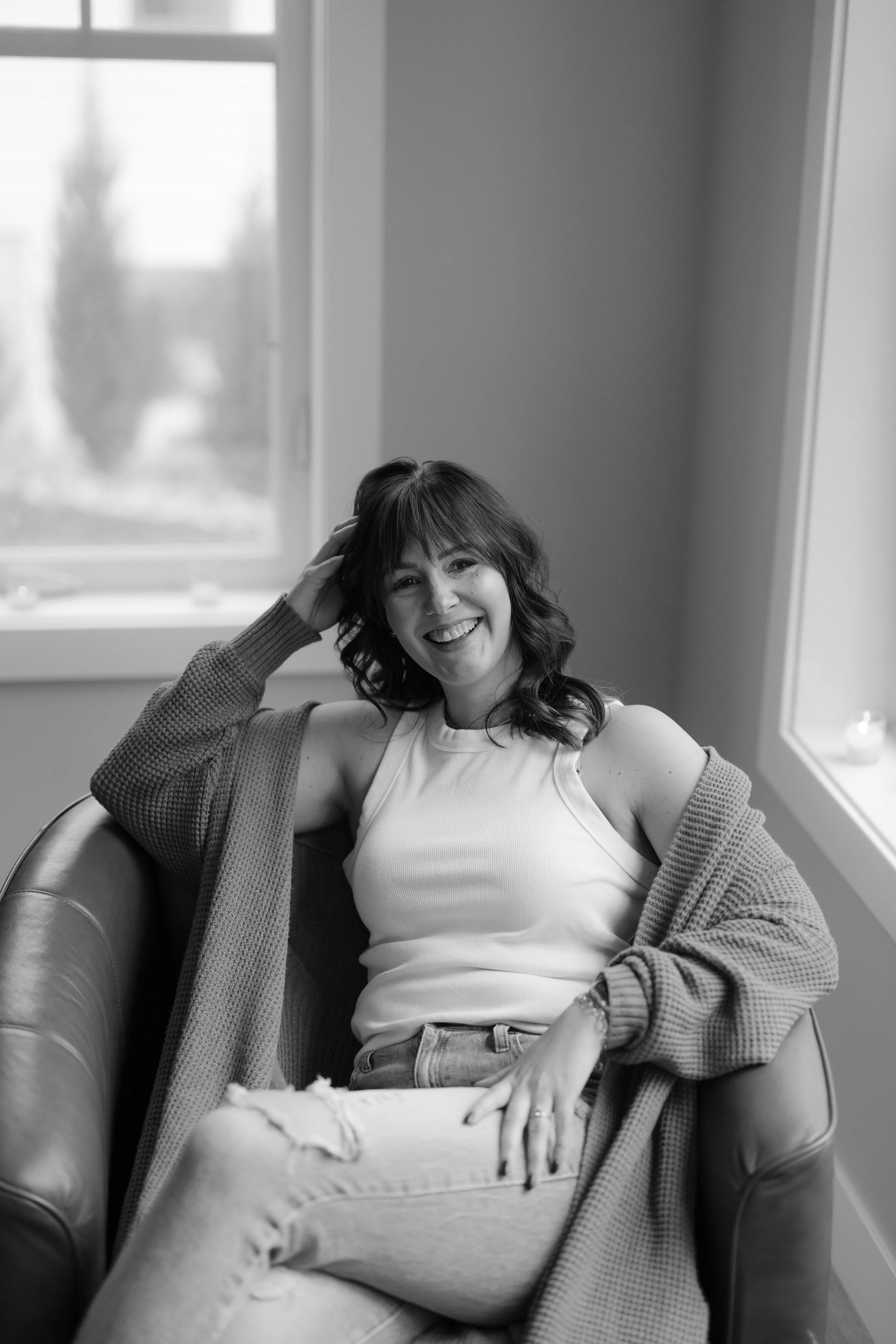
I’m Brooke, and I’ve lived about eighteen lives.
My story began with loss and with it, an early awareness of how quickly identity can be shaped by what’s missing, by what’s expected, by what feels unsafe to fully express. I learned young how to adapt. How to read a room. How to become what was needed. For a long time, I lived inside those boxes.
Theater became an early outlet, a place where I could stretch, feel, express what didn’t have space elsewhere. And later, working with teenagers became an unexpected calling. For years, I walked alongside teenagers as they wrestled with who they were becoming, holding space for their questions, their doubt, their becoming — while quietly navigating my own.
In my next season of life, I worked as a hairstylist and makeup artist, standing with people in some of the most vulnerable, transitional moments of their lives. There’s something sacred about being with someone as they prepare to be seen in those big life shifts. I was drawn again and again to those threshold spaces, where identity softens and reshapes.
Even then, I could feel it, the tension between who we’re told to be and what’s actually true in our bodies.
Fostering siblings deepened that awareness in a way nothing else could. It changed me. It taught me how to become a safe place in the middle of someone else’s storm; how to hold chaos, grief, and complexity without turning away. And it also showed me, very clearly, how often traditional systems, including therapy, miss what the body is carrying. The behaviors made sense when you listened differently.
That realization is what brought me back to school. I wanted to become the kind of therapist I couldn’t find: the kind that doesn’t just listen to words, but to the nervous system, to the unspoken, to the story underneath the story.
And then came a chapter of my life that, on the outside, looked very defined: living in a religious environment, a world that felt impossibly contained. Clear roles. Clear expectations. Very little room for nuance or questioning.
But even there, I couldn’t help myself.
I pushed edges. I asked questions. I reached for something wider, more honest, more embodied than what I had been handed, and I left.
Because underneath all of it, I was still learning how to come home to myself.
The shift didn’t happen all at once. It was gradual. Sometimes uncomfortable. A steady unraveling of the ways I had learned to perform, to conform, to disconnect.
And in its place, something else began to emerge.
More presence.
More openness.
More trust in my own internal knowing.
Less living from expectation and more from embodiment.
Now, everything I do is shaped by that journey. Not from a place of having it all figured out, but from knowing what it’s like to live inside constraints and what it takes to step outside of them.
I’ve never known how to stay small.
Then everything shifted again.
After nine years of infertility, my son, Sawyer, was stillborn. That loss pulled me into the world of perinatal grief, a world I now fiercely advocate within. I’ve created programs, co-led intensives, and held space for couples and women rebuilding themselves in the aftermath of heartbreak.
Along the way, I found experiential therapy and psychodrama, work that pulls people out of their heads and into deep, cellular-level change. Fast. Honest. Transformational.
Today, I help people, especially helpers, leaders, and women who look “fine” on the outside, stop abandoning themselves.
So many are afraid to reach for great when their life is already “good.” But your body always knows when you’re off your path.
My work is about helping you hear that truth, trust it, and come home to yourself, in grief, in growth, and in reinvention.
Because choosing yourself, even when it’s terrifying, is always the beginning of something real.

FAQs
-
Experiential therapy is deep, embodied work that goes beyond talking and into the subconscious patterns held in your nervous system.
Instead of analyzing the story, we work with the part of you that’s reliving it through movement, somatic practices, role-play, guided process work, and body-based emotional release.
This is where the breakthrough happens that talk therapy can’t touch. -
I’m a licensed therapist specializing in perinatal mental health, grief, identity work, and body-based healing.
I’m also trained in experiential modalities, somatic practices, trauma-informed care, and nervous system regulation.And while my clinical background informs the work, these containers go beyond traditional therapy, into the deeper, experiential transformation that creates real, embodied change.
-
Yes. I offer both group immersions and one-on-one containers.
My group experiences are designed for women who want to heal, grow, and expand in community — where connection, reflection, and collective energy amplify the work. -
No.
This work sits outside the medical model and is not billable through insurance.
These are private-pay, high-touch, high-transformation containers designed for accelerated, embodied change. -
Personal Breakthrough focuses on who you are beneath the roles, helping you return to your truth, regulate your nervous system, and shift long-held patterns in your life, relationships, and identity.
Business Expansion focuses on clearing the subconscious and somatic blocks that impact your leadership, visibility, capacity, and wealth so you can grow your business without burning out or abandoning yourself. -
If the primary pain point is your inner world (your emotions, relationships, identity, or patterns) you’re a fit for Personal Breakthrough.
If your business is growing but you feel stuck, overwhelmed, or capped, Business Expansion is the right container.
If you’re unsure, book a discovery call and we’ll feel into it together. -
A discovery call is 30 minutes of honest conversation.
We explore what you’re navigating, what your body is holding, and what you’re desiring.
Together, we’ll see whether this work (and this season) is the right fit. -
Most containers run three months and include three, in-person experiential immersions plus integration support between sessions.
This structure creates deep, accelerated shifts without keeping you in therapy for years. -
Perfect.
Most of my clients come to me after they’ve “talked it to death” but still feel stuck.
Insight isn’t the issue, integration is.
Experiential work unlocks what your mind understands but your body still holds. -
Women who are self-aware, emotionally intelligent, and deeply ready to grow.
Women who are tired of being “fine,” done with shrinking, and willing to tell the truth.
Women who want more (in their lives, their relationships, or their businesses) and are ready to stop abandoning themselves to get it. -
Everything.
Traditional coaching lives in the mind.
This work lives in the body, where the real patterns, fears, limits, and breakthroughs actually sit.
We’re not just talking about change.
We’re creating it. -
Your nervous system leads the work.
We move at the pace your body can hold so you feel grounded, safe, and empowered, not overwhelmed.
This is not about breaking you open; it’s about strengthening your capacity. -
Most women don’t when they arrive, they just know something has to shift.
Clarity comes through the work, not before it.
You don’t need a perfect intention, just an honest yes. -
All immersions happen in person in Metro Detroit.
Integration support is provided virtually between sessions. -
Group containers begin at $555 and 1:1 containers begin at $3,333 for 6 weeks to 3 month immersion.
Details are discussed on your discovery call once we know what you’re wanting and what level of support best fits your season. -
Perfect.
Let’s talk.
Your nervous system usually knows before your mind does, the call gives us space to feel into the truth of what you need.